Quick summary: Ontario’s graduated licensing system applies to every new driver, including newcomers. Your foreign licence can change how you enter the system, but as of 2026, it does not let you skip road tests if your country does not have a reciprocal exchange agreement with Ontario.
The fastest path to a full G licence for most newcomers from non-reciprocal countries is: get your G1 knowledge test done, enroll in BDE immediately to trigger the 8-month G2 window, prepare well for both road tests, and book early because DriveTest slots fill up quickly.
If you are settling in Ajax, Oshawa, Whitby, Pickering, or Bowmanville and want help with your G2 or G road test preparation, get in touch with Sunny Safeway. Instructors come to you across Durham Region.

Moving to a new country means relearning things you thought you already knew, and driving is near the top of that list. Ontario does not simply accept a foreign licence and let you carry on. It has its own three-stage system, its own rules about what your previous experience counts for, and its own timeline for how long each stage takes.
This guide walks through every step of that system for new immigrants in Durham Region, including what you can skip, what you cannot, and how to reach a full Ontario licence as quickly as the rules allow.
What Ontario’s Graduated Licensing System Actually Is
Ontario uses a graduated licensing system (GDL) for all new drivers, whether they are 16-year-olds getting their first licence or adults arriving from another country. There are three stages: G1, G2, and full G. Each stage comes with its own privileges and restrictions, and you must pass a test to advance from one to the next. The system has been in place since 1994. The logic behind it is that new drivers take more risks and have more accidents, so the province structures driving privileges to build up gradually alongside experience. As a newcomer, your path through this system depends heavily on where your foreign licence was issued and how much driving experience you can document.
The Three Stages: G1, G2, and G
G1: Learner’s Permit
The G1 is Ontario’s learner’s permit. To get it, you need to be at least 16 years old, pass a vision test, and pass a written knowledge test covering road rules and road signs. There is no driving at the G1 stage; the knowledge test is done in a DriveTest Centre.
Once you hold a G1, you can drive, but only under specific conditions:
- A fully licensed driver with at least four years of experience must sit in the front passenger seat at all times.
- You cannot drive on 400-series highways or high-speed expressways (as defined by the MTO).
- You cannot drive between midnight and 5 a.m.
- You must maintain a zero blood alcohol level.
- The number of passengers you carry cannot exceed the number of working seatbelts in the vehicle.
- Your supervisor’s blood alcohol level must be below 0.05 (or zero if they are 21 or under).
Without any other steps, you hold G1 for a minimum of 12 months before you can take the G2 road test.
G2: Intermediate Licence
Passing the G2 road test moves you to G2 status. At this stage, you can drive without a supervisor. Most roads are available to you, including 400-series highways. The restrictions that remain apply mainly to drivers under 19 during the first six months of their G2.
You must hold G2 for at least 12 months before taking the final road test for a full G licence. No course or certificate shortens this waiting period.
Full G: Complete Driving Privileges
The G road test is sometimes called the G2 exit test. It tests highway and expressway driving skills, including merging, lane changes at speed, and exit ramp control. Pass it, and all G2 restrictions are removed. You have full driving privileges across Ontario.
How a Foreign Licence Changes Your Path
This is where newcomers often get confused, and the rules changed significantly as of July 1, 2026. Your path through the system depends on which country issued your licence and how much experience you can verify.
If Your Licence Is From a Reciprocal Country
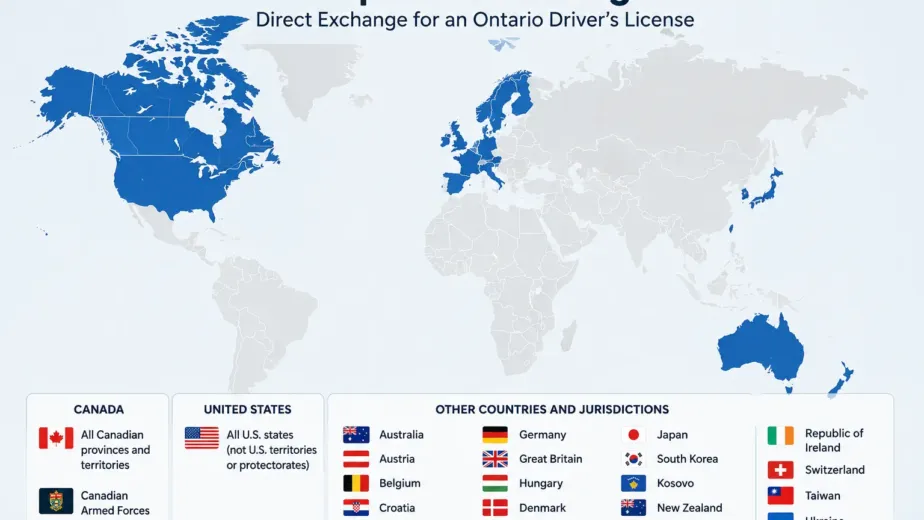
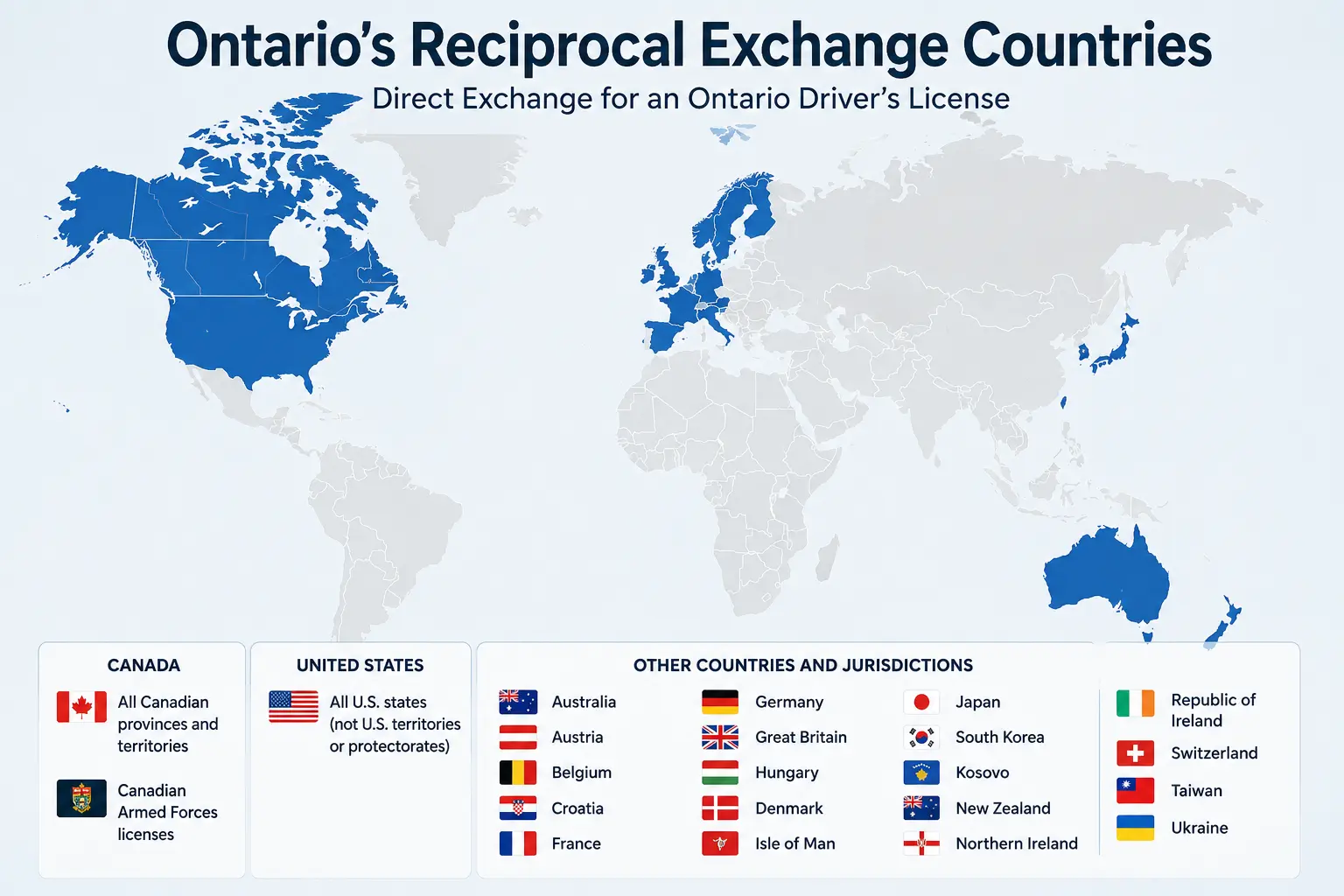
Ontario has exchange agreements with a specific group of jurisdictions. As of 2026, this list includes all Canadian provinces and territories, all U.S. states, Australia, Austria, Belgium, Croatia, Denmark, France, Germany, Great Britain, Hungary, the Isle of Man, Japan, South Korea, Kosovo, New Zealand, Northern Ireland, the Republic of Ireland, Switzerland, Taiwan, and Ukraine.
If your licence is from one of these places and you have at least two years of driving experience within the past three years in an equivalent full licence class, you typically only need a vision test to receive a full Class G Ontario licence. No written test, no road test.
If your experience is less than two years but at least 12 months, you may enter the graduated system with experience credit, meaning the G1 holding period may be reduced or waived entirely depending on your documented experience.
Our guide on how to exchange your foreign driver’s licence in Ontario covers the reciprocal exchange process in full, including the documents you need and common mistakes.
If Your Licence Is From a Non-Reciprocal Country
Most immigrants from countries like India, the Philippines, Nigeria, Pakistan, Bangladesh, Ghana, China, and many others do not fall on Ontario’s reciprocal list. Until mid-2026, some drivers from these countries could use their years of experience to skip large portions of the graduated system. That shortcut no longer exists.
Under the July 1, 2026 rules:
- You can receive a maximum of 12 months of credit for verified foreign driving experience, regardless of how many years you actually have.
- You must complete both the G2 road test and the full G road test.
- You must wait at least 12 months after passing the G2 road test before you are eligible to attempt the G road test.
What the 12-month credit does give you is the ability to skip the G1 holding period. If you can verify 12 or more months of foreign driving experience, you can take the G2 road test immediately after passing your G1 knowledge test, instead of waiting 12 months.
To claim this credit, you need your original valid foreign licence plus an authentication letter from the government agency that issued it, written in English or French, and issued within the last six months. This letter must confirm your licence is genuine and show when you were first licensed.
The table below shows the practical outcomes:
| Your Situation | What Ontario Gives You | Tests Required |
|---|---|---|
| Reciprocal country + 2+ years experience | Full Class G licence | Vision test only |
| Reciprocal country + 12 to 24 months experience | Enter system with experience credit | Vision test + knowledge test; G1 wait may be waived |
| Non-reciprocal country + 12+ months verified experience | Skip G1 holding period | Vision test + knowledge test + G2 road test + G road test |
| Non-reciprocal country + under 12 months verified experience | Partial G1 holding period credit | Vision test + knowledge test + G2 road test + G road test |
| No prior driving experience | Full graduated system from G1 | All stages, full timelines |
If you are arriving with no prior driving experience at all, you go through the full system. Our beginner’s guide to getting an Ontario driver’s licence covers that step by step.
Getting Your Ontario Driver’s Licence as a Newcomer: A Durham Region Guide
If you’ve just moved to Ajax, Oshawa, Whitby, Pickering, or Bowmanville, getting licensed can feel slow and confusing, especially if you drove for years back home. Here’s the process explained plainly, with the local details that actually matter.
Start With the G1 Knowledge Test
Almost everyone begins here. Go to a DriveTest Centre in person, bring acceptable ID (passport, PR card, or other approved documents for your status), pay the fee, and take the test.
The G1 knowledge test is 40 multiple-choice questions: 20 on road rules and 20 on road signs. You need 32 correct (80%) to pass. There’s no time limit.
A few things newcomers find helpful:
- It’s offered in many languages. The Oshawa DriveTest Centre’s computerized test is available in English, French, Arabic, Cantonese, Croatian, Farsi, German, Greek, Hindi, Italian, Korean, Polish, Portuguese, Punjabi, Russian, Somali, Spanish, Tamil, and Urdu. Call ahead if your language isn’t listed.
- Road tests are English or French only, even if you wrote the knowledge test in another language.
- Study the MTO Driver’s Handbook. Every question comes from it. It’s free at ontario.ca, and reading it cover to cover is the most direct way to prepare.
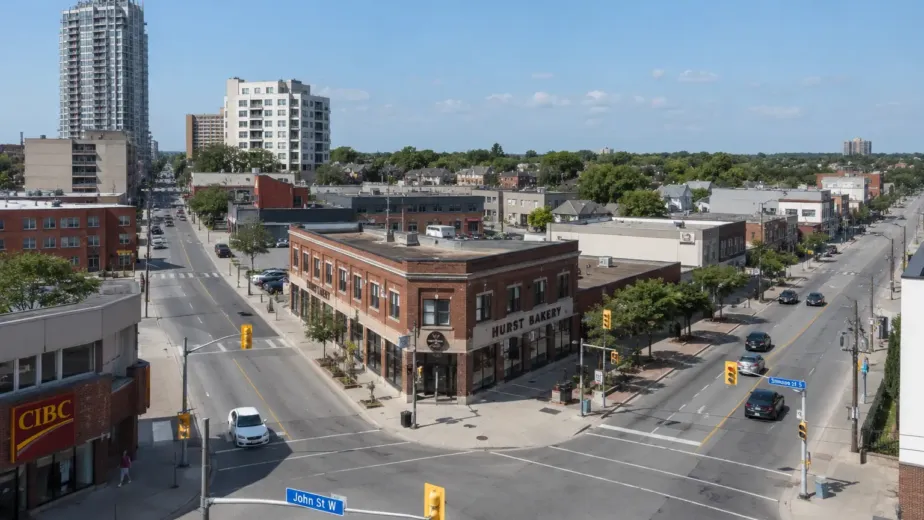
Your local centre: Oshawa DriveTest Centre, inside Midtown Mall at 200 John Street West. It serves all of Durham Region. Book at drivetest.ca.
Living With G1 Restrictions
If you’ve driven for years, the G1 limits can be frustrating. The main ones:
- You can’t drive alone. A fully licensed driver (4+ years’ experience) must sit in the front passenger seat. No supervisor means no driving, not even a quick errand.
- No 400-series highways or designated expressways. Other multi-lane roads are fine.
- No driving between midnight and 5 a.m.
- Zero alcohol and zero drugs, always.
If your licence is from a reciprocal country and still valid, you may be able to keep driving on it for your first 60 days in Ontario while you arrange the exchange. Once you apply for an Ontario licence, that window closes and your Ontario status takes over. (Note: an International Driver’s Permit is for visitors. It does not extend this 60-day window once you’re a resident.)
What BDE Is, and Why It’s Worth It
BDE stands for Beginner Driver Education, an MTO-approved course combining classroom theory with in-car instruction. Completing it does two useful things:
1. It cuts your G1 wait from 12 months to 8. Without BDE, you wait a full year before you can take the G2 road test. With a certificate from an approved school, it drops to 8 months, a real four-month saving.
2. It can lower your insurance. Most Ontario insurers offer BDE graduates a discount, typically around 10 to 15%. As a newcomer building a Canadian record from scratch, your premiums start high, and this is one of the few ways to bring them down early.
The course is 40 hours total: 20 hours of classroom or online theory (usually done at your own pace), 10 hours of in-car instruction with a certified instructor, and 10 flexible hours you can split between extra lessons, homework, or simulator time.
A note for experienced drivers: BDE’s time saving only helps if you are serving a G1 holding period. If you qualify to skip that period with 12 or more months of verified foreign experience, BDE will not get you to G2 any faster, but the insurance discount still makes it worth considering.
BDE isn’t mandatory, but if you want to reach G2 as fast as possible, it’s almost always the right call.
The G2 Road Test
Once you’ve held your G1 for the required time (8 months with BDE, 12 without), you can book the G2 test at the Oshawa centre. The examiner checks practical skills: vehicle control, intersections, lane changes, turns, parking, and general awareness.
You can use your own car, a family member’s, or a friend’s. If you don’t have one, some driving schools provide a vehicle for the test.
Book early. Demand across Ontario is high and slots fill weeks ahead.
Restrictions that remain after you pass G2: zero alcohol and drugs still apply, and drivers under 19 face extra passenger limits in their first six months and overnight.
The Full G Road Test
You must hold your G2 for at least 12 months before the full G test, and nothing shortens this period.
This test focuses on highway and expressway driving: merging at speed, high-speed lane changes, exit ramps, and business-district traffic. It does not re-test parallel parking, 3-point turns, or residential driving, since those were covered at G2.
One thing to confirm beforehand: you’ll need to have driven on a highway with a limit of 80 km/h or more at least five times in the three months before your test. If you can’t confirm this, the examiner marks the test “out of order,” you lose part of your fee, and you get no result. In Durham, that means getting comfortable with the Hwy 401, 412, and 418 merges near the test centre.
Durham-Specific Resources
- DriveTest Centre: Oshawa, Midtown Mall, 200 John Street West. Book at drivetest.ca. Walk-ins accepted, but appointments are recommended for road tests.
- Authentication letters (to claim foreign experience credit): must come from the foreign authority that issued your licence, or its consulate or embassy in Canada. Processing can take weeks, so request yours before you move.
- Translations: if your licence isn’t in English or French, you need a certified translation from an MTO-recognized translator, dated within six months of your appointment.
- BDE and in-car lessons: instructors from MTO-approved schools come to you across Durham, so there’s no need to travel to a school.
Common Mistakes Newcomers Make
- Waiting until the last minute. You have 60 days from establishing residency to get an Ontario licence or qualify for an exchange. Document gathering, especially overseas authentication letters, takes longer than people expect.
- Assuming experience lets you skip tests. Since July 2026, drivers from non-reciprocal countries can’t bypass the G2 or G road test, no matter how long they’ve driven. Experience credit is capped at 12 months, and both tests are mandatory.
- Starting BDE late. The 8-month clock starts when you pass your G1 and enroll. Delay enrolling, and you reach G2 later.
- Underestimating the G1 test. The 80% pass mark trips up people who assume their home-country knowledge transfers. Ontario signs and rules can differ.
Your Realistic Timeline
Your timeline depends on one thing: whether you can document 12 or more months of foreign driving experience.
If you can verify 12+ months of experience (non-reciprocal country)
You skip the G1 holding period, so you do not wait months to take your G2 test.
- Arrive and drive on your foreign licence for up to 60 days.
- Gather documents: valid foreign licence, authentication letter, translation if needed, proof of legal status.
- Pass the vision and G1 knowledge tests at Oshawa. Get your G1.
- Book your G2 road test right away. You can take it as soon as a slot is available, so book early (slots fill weeks ahead).
- Pass the G2 road test.
- Hold G2 for 12 months, building highway experience.
- Book and pass the full G road test.
Realistic total: about 12 to 14 months to a full G licence, most of which is the mandatory 12-month G2 hold. BDE will not shorten this (there is no G1 wait to cut), but it still earns you the insurance discount.
If you cannot document prior experience (or you are a brand-new driver)
You serve the full G1 holding period, which BDE shortens.
- Pass the vision and G1 knowledge tests. Get your G1.
- Enroll in BDE right away. The 8-month clock starts.
- Complete your theory and in-car hours during the wait.
- Month 8: book and pass the G2 road test.
- Hold G2 for 12 months.
- Month 20: book and pass the full G road test.
Realistic total: about 20 months with BDE, or 24 months without. For this path, enrolling in BDE right after your G1 is the single highest-impact move you can make.
Got Questions? We’ve Got Answers.
Can I drive immediately when I arrive in Ontario?
Yes, for up to 60 days on a valid license from your previous province, state, or country, as long as it has not expired.
What if my country has no exchange agreement with Ontario?
You can still get credit for up to 12 months of driving experience with a valid license and an authentication letter, as of July 1, 2026. Beyond that, you complete the standard knowledge test, G2 road test, and G road test process.
Do I need to redo my road test if I have 5 years of experience?
If your license is from a reciprocal country and you have at least 2 years of driving experience in the last 3 years, you typically only need a vision test for a full Class G license. If it is from a non-reciprocal country, credit caps at 12 months regardless of your total experience, and you will need to complete the G2 and G road tests.
Can I use an International Driver's Permit instead of exchanging my license?
No. An IDP is meant to accompany your foreign license if you’re visiting Ontario for more than 3 months as a non-resident. Once you become an Ontario resident, the 60-day exchange rule applies regardless of whether you hold an IDP.
What documents count as proof of legal status under the 2026 rules?
Acceptable documents vary by status: permanent resident card, work permit, study permit, visitor record, or refugee claim documentation, among others. Bring current, unexpired originals to your appointment.
How long does the exchange process take?
If you qualify for a direct exchange (reciprocal country, two or more years of experience), it can often be done in a single DriveTest visit. If you need to build experience credit or complete road tests, plan for several months, since G2 and G road tests each require a minimum holding period.